Serving Mission Viejo for 30+ Years
Expert Roof Coating Application | Mission Viejo Roofing Serving Mission Viejo, CA | Licensed & Insured (C-39) | Silicone, Acrylic & Elastomeric Coatings
Your roof is aging. The shingles show wear, some granules collect in your gutters, maybe a few minor leaks have appeared. A roofing contractor inspects and delivers the verdict: “You need a complete replacement—$18,000–$25,000.” But what if that’s not your only option? What if a professional roof coating system costing $2,000–$5,000 could extend your roof’s life by 10–15 years, giving you time to plan and budget for eventual replacement while maintaining full protection?
Roof coatings aren’t appropriate for every situation—severely damaged roofs with structural issues need replacement, not coating. But for roofs in the “middle years” showing moderate wear without critical damage, professional coating systems offer a compelling value proposition that most homeowners never hear about because there’s less profit in a $3,000 coating job than a $20,000 replacement.
This page exists to help Mission Viejo homeowners understand when roof coatings make sense, which coating types perform best in our climate, and how to maximize the life-extension and energy-saving benefits these systems provide. We’ll be honest about when coatings work and when replacement is the only sensible option—because our goal is helping you make the right decision for your situation, not maximizing our invoice.
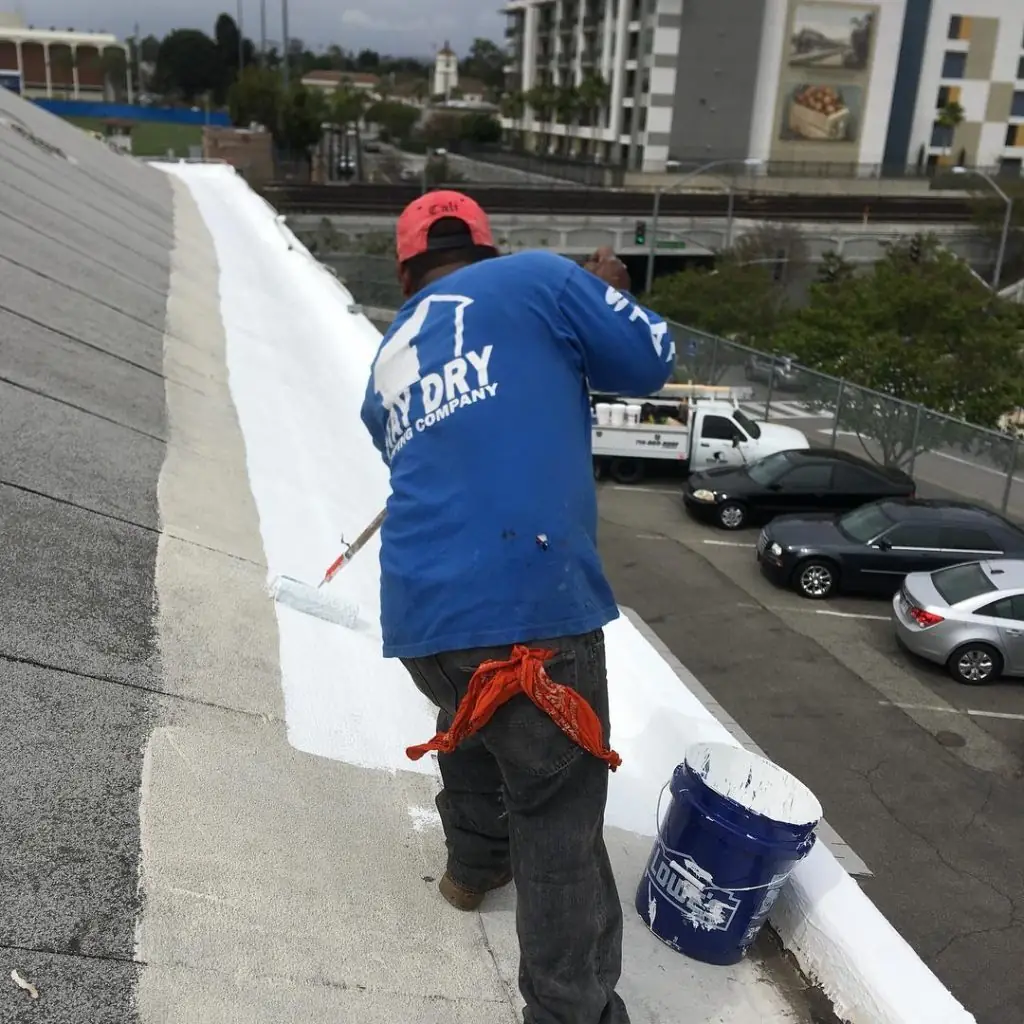
A roof coating is a fluid-applied membrane that cures into a seamless, monolithic protective layer over your existing roof.2 Think of it as a thick, durable paint specifically engineered to withstand UV radiation, thermal cycling, wind-driven rain, and foot traffic while providing waterproofing, heat reflection, and surface protection.3
Modern roof coatings are sophisticated products engineered for specific performance characteristics:4
The resulting system, when properly applied, creates a protective membrane typically 10–30 mils thick (that’s $0.010$-$0.030$ inches) that seals the roof surface, fills hairline cracks, bonds to the substrate, and creates a new weather-resistant surface.
Roof coatings work through multiple protective mechanisms:
Roof coatings work through multiple protective mechanisms:
Not all coatings deliver equal performance. The six main types have distinct characteristics that make them suited for different roof types and conditions.
| Chemistry | 100% silicone polymers that cure through moisture reaction (atmospheric humidity) |
| Performance Characteristics | Superior waterproofing (excellent for ponding water), excellent UV resistance, maintains thickness, temperature flexibility ($-40^\circ\text{F}$ to $300^\circ\text{F}+$ range). |
| Reflectivity | $85\%$-$90\%$ initially, maintaining $75\%$-$85\%$ long-term. |
| Lifespan | 15–20+ years with proper maintenance. |
| Cost (Installed) | $1.50–$3.00 per square foot installed ($3,000–$6,000 for 2,000 sq ft roof). |
| Best for Mission Viejo | Flat or low-slope roofs (under 3:12 pitch), roofs with ponding water issues, metal roofs needing maximum UV protection, BUR and modified bitumen, longest lifespan coating. |
| Limitations | Attracts dirt (less aesthetically attractive), slippery when wet (safety concern), premium cost, not typically used on steep-slope asphalt shingle roofs. |
| Chemistry | Water-based acrylic polymers (similar to high-quality exterior paint but much thicker and more durable) |
| Performance Characteristics | Good UV resistance, excellent dirt resistance (stays cleaner than silicone), breathable (allows moisture vapor transmission), easy cleanup and application. |
| Reflectivity | $80\%$-$85\%$ initially, maintaining $70\%$-$75\%$ long-term. |
| Lifespan | 7–12 years typically, 15+ years with proper maintenance and recoating. |
| Cost (Installed) | $0.75–$2.00 per square foot installed ($1,500–$4,000 for 2,000 sq ft roof). |
| Best for Mission Viejo | Metal roofs, sloped roofs with good drainage, asphalt shingles (with proper primer), SPF roofs, budget-conscious projects, roofs requiring aesthetic appearance. |
| Limitations | Poor performance in ponding water (breaks down quickly), shorter lifespan than silicone or polyurethane, requires recoating more frequently, can erode over time (loses thickness gradually). |
| Chemistry | Two-component reactive polyurethane (aromatic or aliphatic formulations) |
| Performance Characteristics | Highest impact resistance (can handle foot traffic, hail, debris), excellent abrasion resistance, superior adhesion, rapid cure time. |
| Reflectivity | 70–80% (aliphatic versions maintain better than aromatic). |
| Lifespan | 15–25 years with proper application. |
| Cost (Installed) | $1.75–$3.50 per square foot installed ($3,500–$7,000 for 2,000 sq ft roof). |
| Best for Mission Viejo | Roofs requiring foot traffic (HVAC access), metal roofs needing maximum durability, base coat under acrylic topcoat systems, roofs exposed to mechanical damage. |
| Limitations | Complex application (two-component mixing, narrow temperature window), Aromatic versions yellow over time, often requires topcoat for UV protection, professional application essential. |
| Chemistry | Rubber-like polymer blends (typically acrylic-elastomeric or polyurethane-elastomeric combinations) |
| Performance Characteristics | High flexibility (accommodates expansion/contraction), good crack-bridging ability, weather-resistant, available in various colors. |
| Reflectivity | 75–85% for white formulations. |
| Lifespan | 10–15 years typically. |
| Cost (Installed) | $1.00–$2.50 per square foot installed ($2,000–$5,000 for 2,000 sq ft roof). |
| Best for Mission Viejo | Asphalt shingle roofs (bridges cracks as shingles age), stucco walls adjacent to rooflines, roofs experiencing thermal movement, multi-substrate applications. |
| Limitations | Can trap moisture if substrate isn’t properly prepared, variable quality between manufacturers, may chalk or fade over time. |
| Chemistry | EPDM or similar rubber polymers in liquid form |
| Performance Characteristics | Creates seamless rubber membrane, excellent flexibility, good waterproofing, self-leveling properties. |
| Reflectivity | Variable (black versions don’t reflect; white versions 75–80%). |
| Lifespan | 10–20 years. |
| Cost (Installed) | $1.50–$2.50 per square foot installed ($3,000–$5,000 for 2,000 sq ft roof). |
| Best for Mission Viejo | Flat roofs, RV roofs, metal roofs, single-ply membrane repairs. |
| Chemistry | Asphalt or coal tar pitch with mineral fibers or aluminum |
| Performance Characteristics | Excellent waterproofing, good for built-up roofs (BUR), low cost, proven track record. |
| Reflectivity | Poor (black coatings absorb heat). |
| Lifespan | 5–10 years. |
| Cost (Installed) | $0.50–$1.50 per square foot installed ($1,000–$3,000 for 2,000 sq ft roof). |
| Best for Mission Viejo | Built-up roofing maintenance, emergency repairs on asphalt-based systems, budget-constrained commercial applications. |
| Limitations | No solar reflectance (increases heat absorption), shorter lifespan, strong odor during application, not environmentally friendly. |
OUR MISSION VIEJO RECOMMENDATIONS:
Given Mission Viejo’s climate (intense UV, minimal ponding water concerns, hot summers), acrylic and silicone coatings deliver the best performance for most applications.
This is the most important section of this page. Coatings are not universally applicable—using them inappropriately wastes money and creates problems.
Your roof is a good coating candidate if ALL of these conditions are met:
Do NOT coat your roof if ANY of these conditions exist:
The Honest Assessment: We estimate 30–40% of roofs homeowners want to coat are poor candidates. In these cases, we recommend replacement even though it costs us a coating job—because we know coating a failing roof wastes your money and damages our reputation when it fails prematurely.
Climate dramatically affects coating performance. Mission Viejo’s specific conditions favor certain coating types and application strategies.
One of the biggest selling points for roof coatings is energy savings through solar reflectance.1 Here’s the honest truth about what you can expect in Mission Viejo.
Based on field studies and our experience, here’s what Mission Viejo homeowners can expect:
The Honest Assessment: Energy savings alone don’t justify coating economically in most cases. The primary value is roof life extension; energy savings are a valuable bonus but not the main justification.
Beyond direct cooling cost reduction:
Professional coating application is a multi-step process.10 Understanding what’s involved helps you evaluate contractor proposals and ensure quality work.
Thorough inspection determines coating feasibility:
We provide detailed assessment report with photos documenting current condition, identification of required repairs, coating recommendations, honest opinion on coating viability vs. replacement, and written proposal with scope of work and pricing.
Preparation is 60% of a successful coating project:
Poor preparation is the #1 cause of coating failures. We don’t cut corners here.
Professional application techniques ensure proper coverage and performance:
Before considering the job complete:
Typical Timeline:
Weather is a major factor—cannot apply coatings in rain, extreme heat ($95^\circ\text{F}+$), or high winds. Plan buffer time for weather delays.
A professionally applied coating system requires minimal maintenance but benefits from periodic attention.
Schedule professional inspection every 12–18 months:
Early detection of minor issues prevents major problems.
Mission Viejo’s low rainfall means dirt accumulates:
DO NOT pressure wash at high pressure—damages coating. Use 1,000–1,500 PSI maximum with wide fan tip.
Eventually, coatings need refreshing:
| Coating Type | Recoating Frequency | Cost Benefit |
| Silicone | Every 15–20 years | Recoating costs less than initial application (50-70% of original cost) because substrate preparation is minimal. |
| Acrylic | Every 8–12 years | Recoating costs less than initial application (50-70% of original cost) because substrate preparation is minimal. |
| Polyurethane | Every 15–20 years | Recoating costs less than initial application (50-70% of original cost) because substrate preparation is minimal. |
| Elastomeric | Every 10–15 years | Recoating costs less than initial application (50-70% of original cost) because substrate preparation is minimal. |
Yes, but with important caveats. Asphalt shingles can be coated with specialized elastomeric coatings designed for shingle substrates. Benefits include filling hairline cracks, sealing granule loss areas, extending shingle life 5-10 years, improving reflectivity (energy savings). However, coating doesn't work if shingles are severely deteriorated (brittle, curling, extensive granule loss), structural issues exist (rotted decking, failed underlayment), or the roof has less than 5 years remaining useful life. Our recommendation: Consider coating for shingle roofs in the 12-18 year range showing moderate wear. By year 20+, replacement is usually the better investment. We assess your specific roof honestly and recommend coating only when it makes financial sense.
Lifespan depends on coating type, application quality, substrate condition, and maintenance: Silicone: 15-20+ years, Acrylic: 7-12 years (15+ with recoating), Polyurethane: 15-25 years, Elastomeric: 10-15 years. Mission Viejo's climate (intense UV, minimal moisture) favors long coating lifespans for quality products with good UV resistance. Properly applied silicone coatings regularly exceed 20 years here. Cheap, thin applications fail in 3-5 years—another reason professional application matters. Recoating before complete failure extends life indefinitely—you can maintain a coating system perpetually if the underlying roof structure remains sound.
Coating seals hairline cracks and creates a waterproof membrane, so it CAN fix minor leaks caused by surface deterioration, hairline cracks in flat roofing, aging sealants around penetrations, and surface porosity in aging materials. Coating CANNOT fix leaks caused by structural damage, torn or punctured membranes, failed flashing systems, or rotted roof decking. Think of coating as preventive medicine and minor leak repair—not major surgery. If you have multiple active leaks or severe damage, coating is the wrong solution. We identify all leak sources during assessment and repair them before coating.
We strongly recommend professional application for several reasons: Proper preparation is critical (power washing, repairs, priming), application technique affects performance (mil thickness, coverage uniformity), product selection requires expertise (wrong coating for substrate causes failures), safety concerns (working on roofs is dangerous), warranty protection (most manufacturer warranties require professional installation), and time investment (DIY takes 3-5X longer than professional crews). That said, small projects (shed roofs, single-story accessible areas) can be DIY with proper research and product selection. Large, complex, or steep roofs should always be professionally coated.
Costs vary based on roof size, coating type, prep work required, and roof complexity: Acrylic coating: $0.75-$2.00 per sq ft ($1,500-$4,000 for 2,000 sq ft roof), Silicone coating: $1.50-$3.00 per sq ft ($3,000-$6,000 for 2,000 sq ft roof), Elastomeric: $1.00-$2.50 per sq ft ($2,000-$5,000 for 2,000 sq ft roof). These prices include prep work, cleaning, minor repairs, two-coat application, and cleanup. Extensive repairs, structural work, or severely deteriorated roofs cost more. Compare coating costs to replacement ($8,000-$25,000+) and consider the value proposition. If coating extends your roof life 10-15 years, you're paying $200-$500 annually for roof protection—far less than replacement would cost when amortized.
Yes, but the savings are moderate, not dramatic. Realistic expectations for Mission Viejo: 15-30% cooling cost reduction during summer months, $60-$100 per month savings June-September, $240-$400 annual savings. Variables: Attic insulation level (biggest factor—well-insulated homes see smaller coating impact), HVAC efficiency (newer systems already efficient), home size and ceiling height, thermostat settings. Energy savings alone don't justify coating economically (7-12 year payback). The primary value is roof life extension; energy savings are a bonus. However, in Mission Viejo's hot climate, every degree of cooling reduction helps comfort and equipment longevity.
Not the tiles themselves, but you can coat the underlayment during tile maintenance. Spanish tile roofs in Mission Viejo are common. The concrete or clay tiles last 40-50+ years, but the underlayment deteriorates in 20-25 years. The process: Carefully remove tiles, inspect and repair underlayment or install new underlayment, apply coating system to underlayment for additional protection, reinstall tiles properly. This preserves your beautiful tile roof while ensuring waterproof protection. The coating adds 5-10 years to underlayment life, delaying the need for complete tile removal and reroof. This is a specialized application—not all contractors handle tile roof coating properly.
Depends on coating type and weather conditions: Acrylic: Typically 4-8 hours until dry to touch, 24-48 hours for full cure. Silicone: 1-4 hours until tack-free, 24 hours for trafficable cure. Elastomeric: 8-24 hours typically. Hot, dry Mission Viejo weather accelerates cure times. Conversely, cool or humid conditions slow curing. We provide specific guidance based on product and conditions. During application, the roof is a no-go zone. After cure, minimize traffic—coatings are durable but not indestructible. Use walkway pads if frequent access is needed (HVAC maintenance, etc.).
Most Mission Viejo HOAs approve roof coating for flat or low-slope roofs because the coating is typically white or light-colored and not prominently visible. Pitched roofs visible from streets may face more scrutiny—some HOAs prefer specific colors or prohibit appearance changes. Process: Submit coating proposal to HOA architectural committee, include material specifications and color samples, provide photos showing current roof condition, obtain written approval before starting work. We help navigate HOA requirements and have experience with Mission Viejo's major HOAs. Most approvals take 2-4 weeks.
If your roof is showing age but isn’t ready for replacement, professional coating might be the perfect solution—extending life by 10–15 years, reducing cooling costs by 15-30%, avoiding replacement expense for a decade+, and protecting your home completely for a fraction of replacement cost.
We provide honest assessments—if your roof isn’t a good coating candidate, we’ll tell you and explain why replacement is the better choice. If coating makes sense, we’ll recommend the optimal product for your roof type and budget.
Call Mission Viejo Roofing today to schedule your free roof coating assessment. We’ll inspect your roof, provide honest recommendations, explain your options, and answer all your questions.
Mission Viejo Roofing – Licensed, Bonded & Insured (C-39)
Solar-Ready Roofing Experts Serving Mission Viejo Since [Year]
📞 Phone: (949)-528-7663
✉️ Email: roofer714@gmail.com
📍 Address: 26040 Acero Suite 202 Mission Viejo CA 92691
Sometimes the best solution isn’t the most expensive one. Let’s see if coating makes sense for your roof.
CITATIONS: